
Blue Economy, Innovation, and Sustainability
FIEC Hosts Global Event to Drive the Ocean Economy and Technological Innovation in Ceará
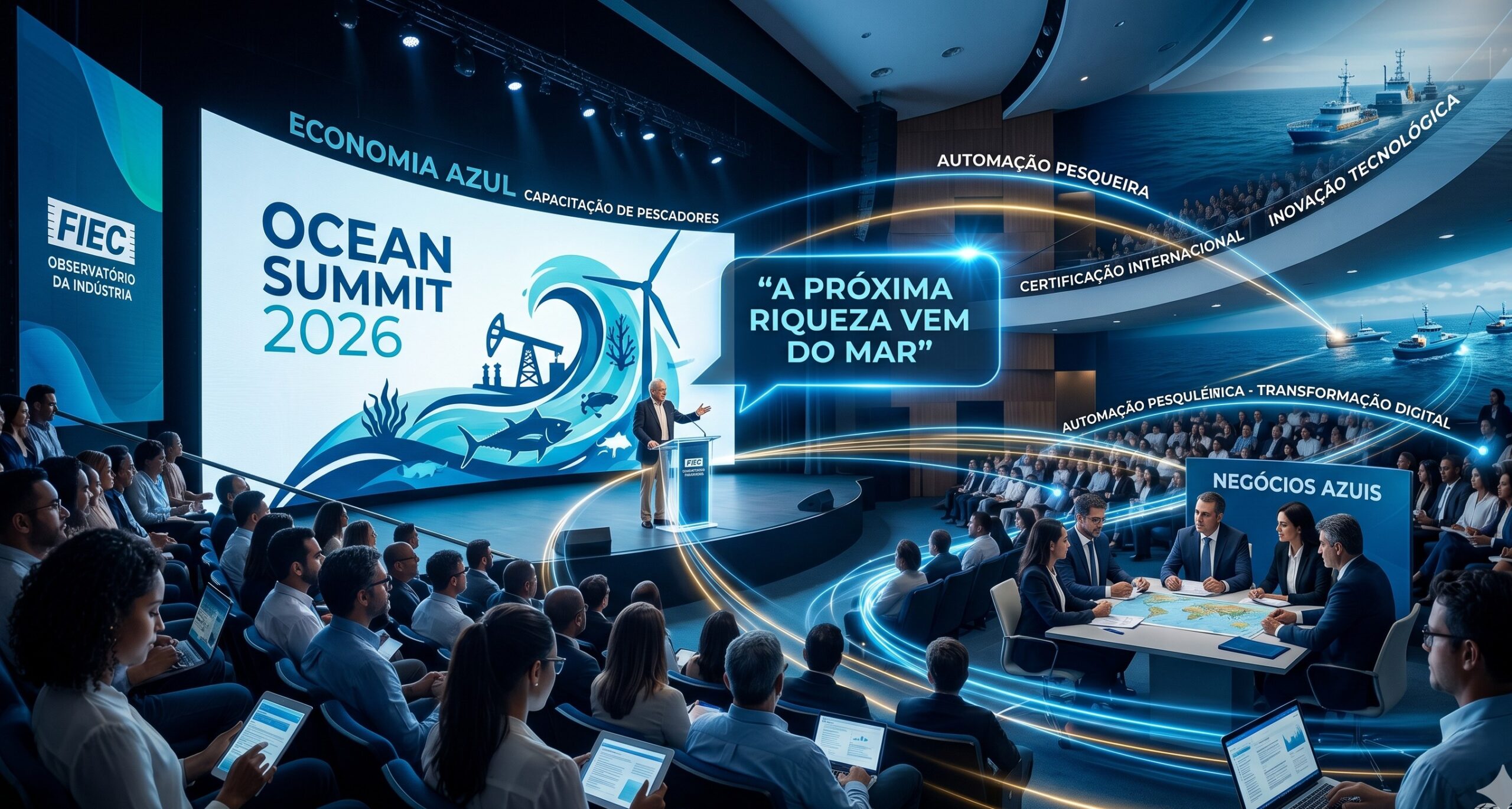
FORTALEZA – The Casa da Indústria, headquarters of the Federation of Industries of the State of Ceará (FIEC), transforms starting today into the epicenter of debates regarding the future of oceans in Latin America. Held this Monday and Tuesday, the Ocean Summit 2026 gathers the entire value chain of the so-called Blue Economy (or Ocean Economy)—a concept encompassing economic activities dedicated to the sustainable extraction, exploration, and preservation of marine wealth, spanning from deep-sea fishing to offshore wind power generation and oil exploration.
This vanguard event is promoted by the Industry Observatory—the technological arm of FIEC—in partnership with the Euvaldo Lodi Institute (IEL), also a member of the FIEC System. The gathering attracts a highly qualified audience comprising entrepreneurs, investors, executives, researchers, professors, and university students, while also featuring structured B2B matchmaking sessions designed to connect investors with business owners focused on the sustainable development of the sea.
“Sustainable Oil”: The Multi-Billion-Dollar Potential of Seaweed
The official opening of the Ocean Summit 2026 was marked by a keynote speech from Belgian entrepreneur and scientist Gunter Pauli, the pioneer behind the term “Blue Economy.” According to Pauli, the ocean depths will be the primary suppliers of new medicines, chemical inputs, and construction solutions for the society of the future.
The scientist recalled the guidelines he originally shared with the FIEC business delegation during an international mission to Portugal, pointing out a highly lucrative and still under-explored market:
“Anyone who wants to get rich, very rich, must invest in the production and industrial processing of seaweed. Brazil, with over 8,000 kilometers of coastline, has everything required to produce these algae and their highly valuable byproducts on a large scale. Seaweed is just as valuable as oil, with one distinct advantage: it integrates into the Blue Economy, meaning it is a 100% sustainable and a thousand times more profitable activity.”
Structural Challenges and the Technological Turnaround in Ceará
Currently, the Blue Economy is responsible for employing over 4,000 people in Ceará. However, historical data from the Industry Observatory indicated that this workforce and the sector’s revenue could be significantly larger if there were an integrated production strategy.
The Ceará fishing sector, for instance, previously faced a severe lack of technological integration, operating extensively with manual processes in both the extraction and processing of seafood. A lack of technical training also prevented local workers from meeting the strict sanitary and sustainability standards required by national and international regulatory bodies.
Since then, Ceará has advanced consistently in exploring its 600 kilometers of coastline. Led by FIEC, private and public investments have expanded with a focus on coastal tourism and the capture and processing of premium seafood, consolidating the state as the largest lobster exporter in the country and a strategic supplier of fish such as tuna and red snapper to the demanding American and Asian markets.
FIEC’s Action Plan for the Ocean Economy
To accelerate this transition and overcome the barriers imposed by globalization, the Industry Observatory is developing a robust program to incentivize and support the Blue Economy. The project is structured around six clear strategic targets:
- Process Automation: Incorporating technology and automation into the fishing supply chain, eliminating manual bottlenecks.
- Digital Transformation: Inducing digitalization and data usage within aquaculture enterprises.
- Data Intelligence: Structuring solid, high-quality databases regarding the sector’s potential to support strategic planning.
- Knowledge Dissemination: Promoting major events to debate the importance and economic potential of the Ocean Economy.
- Legal Compliance: Adapting and modernizing local fishing vessels to align with current environmental and maritime legislation.
- International Certification: Promoting actions that enable Ceará’s fishing activities to secure international seals and certifications, opening the doors to the most demanding global markets.
A Globally Expanding Market
The necessity of these actions is backed by global market studies. Research by the consultancy firm PwC indicates that nearly all activities tied to the ocean economy are recording accelerated growth. Among the main expanding global indicators are:
- Annual Container Movement: Up 26.77%
- Natural Gas Extraction: Up 17.65%
- Mollusk Production (Shrimp, Oysters, Mussels): Up 10.14%
- Vessel Movement: Up 9.29%
- Annual Aquaculture Production: Up 8.86%
The Institutional Link with the CTN Hub
The maturation of the Blue Economy in Ceará perfectly reflects the high-performance business environment championed by the CTN Hub (Ceará Today Network).
Sovereign & Corporate Investment: For global funds and corporations seeking to capitalize on the potential of the Ceará coastline—whether in offshore wind farms, marine biotechnology, or port logistics—the CTN Hub and the Global Development Agency offer technical support, consolidated economic data, and strategic intelligence advisory services to enable long-term partnerships at the vertex of the South Atlantic.